
💼 The Complete Guide to Recruiting & Job Platform Landing Pages: Best Practices, Examples, and Conversion Strategies
In today's competitive recruiting and talent acquisition landscape, a well-designed landing page can be the difference between a visitor bouncing and a new job seeker or employer signing up. This comprehensive guide explores everything you need to know about creating high-converting recruiting and job platform landing pages that drive registrations and engagement.
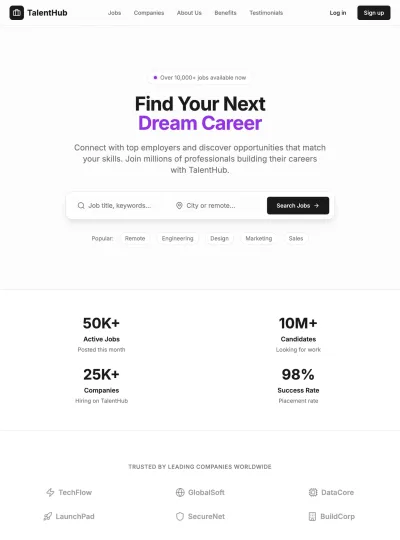
Template Preview
See what your saas landing page will look like
What Makes Recruiting Landing Pages Unique?
Recruiting and job platform landing pages require a specialized approach because they serve two audiences—job seekers and employers—and must build trust around real opportunities. Unlike generic landing pages, recruiting pages must:
- Show live job counts and key stats (e.g., "50K+ Active Jobs," "10M+ Candidates") to signal scale and activity.
- Build trust through company logos, testimonials from both candidates and employers, and verified-employer badges.
- Guide visitors toward low-friction sign-up (e.g., "Sign up," "Search Jobs") with clear CTAs for both job seekers and employers.
Research shows that industry-specific landing pages convert 3-5x better than generic alternatives because they speak directly to the visitor's context—whether they are looking for a job or looking to hire.
Essential Elements of High-Converting Recruiting Landing Pages
1. Compelling Hero Section
Your hero section must immediately communicate value and encourage search or sign-up.
- Lead with a clear, outcome-focused headline (e.g., "Find Your Next Dream Career" or "Connect with Top Talent").
- Include a job search bar (keywords + location/remote) so visitors can act without leaving the page.
- Feature trust signals such as "Over 10,000+ jobs available now" or "Join millions of professionals."
- A prominent Call-to-Action for both "Sign up" and "Search Jobs" (or "Log in" for returning users).
2. Social Proof and Trust Signals
In the recruiting industry, trust is paramount because both job seekers and employers are making high-stakes decisions. The most powerful forms of social proof include:
- Company logos of employers using the platform ("Trusted by leading companies worldwide").
- Testimonials from job seekers who landed roles and from employers who found talent.
- Key metrics (active jobs, registered candidates, placement or success rate).
- Verified employer or quality badges to reduce fear of scams.
3. Clear Value Proposition
Your value proposition answers: "Why use this platform instead of others?" Focus on outcomes for both audiences.
- For job seekers: Smart job matching, direct employer contact, career resources, real-time updates.
- For employers: Quality candidates, faster hiring, verified profiles, and reach to a large talent pool.
- Use concrete numbers (e.g., "98% placement rate," "25K+ companies hiring on our platform").
4. Strategic Call-to-Action Placement
The most effective recruiting landing pages include multiple CTAs at strategic points.
- Primary CTAs in the hero: "Search Jobs," "Sign up," "Get Started."
- Secondary CTAs after featured jobs, benefits, and testimonials: "View all jobs," "Create your profile," "Post a job."
- Use audience-specific CTAs: "For Job Seekers" and "For Employers" in the nav or footer.
Conversion Optimization Strategies for Recruiting Pages
Mobile-First Design
A large share of job search traffic comes from mobile. Design your page mobile-first:
- Make the search bar and CTAs thumb-friendly and easy to tap.
- Keep forms short (e.g., email + password for sign-up; keyword + location for search).
Page Speed and Performance
Page speed directly impacts conversion—slow pages increase bounce rates. Optimize images (company logos, hero graphics) and aim for a load time under 3 seconds on mobile.
A/B Testing and Iteration
Test high-impact elements such as:
- Headlines (e.g., "Find Your Dream Career" vs. "10,000+ Jobs Waiting for You").
- CTA copy ("Sign up" vs. "Get Started Free" vs. "Create Profile").
- Hero layout (search bar above the fold vs. sign-up form).
Common Mistakes to Avoid
- Vague or generic headlines: Avoid "We Help You Find Jobs." Use specific, benefit-driven copy (e.g., "Find Your Next Dream Career").
- No social proof: Without company logos, job counts, or testimonials, visitors have no reason to trust the platform.
- Hidden or confusing CTAs: Make "Sign up" and "Search Jobs" prominent and clear for both audiences.
- Too much information above the fold: Focus on one primary action (search or sign-up) and support it with a short subheadline and trust line.
- Slow load times: Optimize for speed so job seekers and employers don't abandon the page.
Measuring Success: Key Metrics for Recruiting Landing Pages
To optimize your recruiting landing page, focus on these Key Performance Indicators (KPIs):
| Metric | Definition | Typical Goal |
|---|---|---|
| Sign-Up Rate | Percentage of visitors who create an account (job seeker or employer). | Aim for 2-5% or higher. |
| Search Usage Rate | Percentage of visitors who use the job search bar. | Indicates intent; goal is to maximize search then convert to sign-up. |
| Bounce Rate | Percentage of visitors who leave without interacting. | Aim for rates below 60%. |
| Time on Page | How long visitors spend before converting or leaving. | 60-90 seconds indicates engagement with jobs and benefits. |
| CTA Click-Through Rate | Clicks on "Sign up," "Search Jobs," or "Post a job." | Track by CTA to see which audience and message perform best. |
Getting Started with Your Recruiting Landing Page
Building a high-converting recruiting or job platform landing page doesn't have to take weeks. You can launch a professional, optimized page in hours by following these steps:
- Start with a proven template designed specifically for recruiting and job platforms.
- Customize it with your value proposition, key stats, and audience-specific messaging (job seekers vs. employers).
- Add company logos, testimonials, and featured jobs (or job categories) to build trust.
- Optimize the hero search bar and CTAs for mobile and speed.
- Launch with analytics tracking to measure sign-ups, search usage, and CTA performance.
Frequently Asked Questions
Ready to Create Your Recruiting Landing Page?
Start with our proven template and customize it for your job platform in minutes.